Keeping a Spare Clothing Kit Ready for a Soaked Day Outdoors
Damp clothing feels cold and clammy at first, but it can quickly become a major issue. Soaked cuffs, wet waistbands, and sweaty sleeves all feel unpleasant after a while and can be reinforced by your slowing movement as you come to a stop. Having a good supply of spare clothing to change into in a safe place, could be all that is required to prevent discomfort affecting concentration, safe movement and your decision to stay out longer. Consider the hunter that drove to a woodland access point under forecast of rain, set off on his walk in the wet and now needs to change his clothes in his vehicle.
Start with the trip, not a standard packing list
When deciding how much clothing to take for a spare change, you need to consider where you will be changing into your dry clothes. If the vehicle is parked near the access point, then a complete change can be stored in the vehicle. However, if the route to your stand takes a long time, involves a boat crossing or a long and rough return then you will also need to take an emergency layer for a quick change.
As a hunter, you need to determine what will get wet and pack accordingly. A waterproof shell will probably keep your base layer dry, but your trousers may get wet from sitting on wet vegetation. Your gloves are probably going to get wet first, followed by your socks. You may get your socks wet on the in, but they'll likely get wet on subsequent stops. Your gloves may get wet on the in, too. So, your spare items would be items that are likely to get wet and are easily replaced, such as an extra pair of socks.
Packing in systems (next-to-skin clothing, insulating clothing, weather protection, foot accessories) and choosing the items that will solve the most likely, noticeable and worst problems and that cannot be solved with what you are already wearing, will result in a useful spare clothing kit.
Pack the pieces that restore comfort fastest
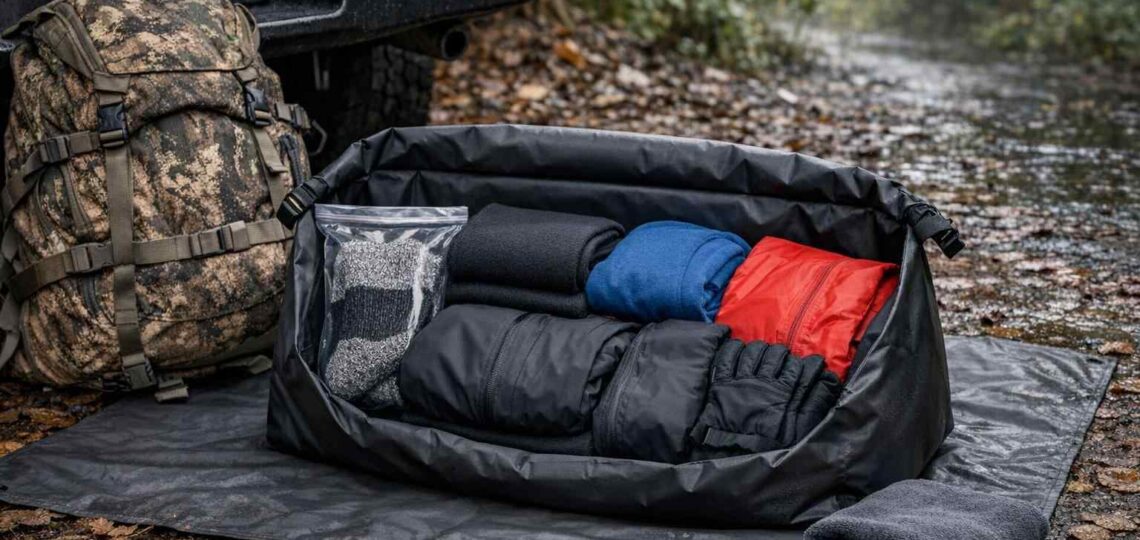
One hunter's spare clothing to bring consists of: dry socks, underwear or the bottom half of his base layer, a long-sleeved shirt for cold weather, a mid-layer for insulation and the remainder of his clothes, i.e. trousers, hat. Include his gloves too but bring different ones for different purposes, i.e. thin liners for dexterity, thick ones for warmth when he's driving home or sitting about.
Socks can be added quite easily to your spare clothing kit. Packs containing dry socks take up very little room and can be a valuable contribution to your clothing. Store clean socks in a sealed bag within your main spare clothing kit. That way the dry clothing will not get wet from a damp pack that has been left on the floor or leaked from somewhere. Also the socks in the sealed bag in a covered vehicle compartment will not get wet from any mud etc that may have been left on the floor of the compartment.
Instead look for clothes to replace the same problems i.e. if i get sweaty under my rain clothing a dry base layer would be much better than another thick outer layer. Later when i'm cold after having been standing for long periods a good insulating layer would be better than another thick outer garment.
Keep wet weather gear separate from dry clothing
Keep water protection gear (such as your shell and rain trousers) separate from your dry change clothing. The purpose of the water protection is to keep moisture out while you're outside, while your spare clothing is to help you recover from times when the water protection doesn't work and you get wet, or when your clothing has gotten wet from your own sweat after prolonged periods of physical activity, or even when you're stuck sitting in one place for a long time and your clothing gets wet from all of the moisture around you.
All dry clothing should be stored in separate bags to the wet weather gear. These can be simple roll-top bags or tough zip up pouches. It's worth to open them up occasionally and to check the closure and the seams for signs of deterioration.
Also be sure to keep your wet weather gear separate from your dry clothing, and store them in separate bags. That way when you do need to get into your dry clothing you can just pull out what you need and close the bag up again. If it's going to be a long time before you can change completely you can store your dry clothing in a roll-top bag or in a zippered pouch in the back of your vehicle.
Test the kit before the forecast tests you
Make sure that any replacement clothing will fit over all of the clothing that you are currently wearing, including any belts, bibs, packs, etc. Test trousers for length and make sure that sleeves will not be constricted when worn with any layer. Also check that gloves can be put on and taken off while wearing the clothing that you currently have on and that you will be able to use your hands to do up zippers, etc.
Before packing replacement clothing items, wash and dry them all. Check for worn out areas like broken elastic or worn out seams and take them out of your "backup clothing". Also, toss any items with strong odors or that are persistently damp. Clothing that feels okay in your warm house may feel awful when you're cold, tired and changing in the side of your vehicle.
Just before you head out look for dry socks, a spare insulating layer, a spare outer layer and your spare hat and gloves. Even better, after each trip re-pack your backup kit so that the items that you have used on the trip are not left in your car or gets mixed up with your dry clothes.
Decide when changing is worth the interruption
Changing outside of your vehicle does not have to mean it is safer. Visibility, slippy terrain, and the risk of having to move to a less safe location to change are all factors that you must consider. Could you change elsewhere?
However, sometimes it is not worth changing your clothing. For example, if you are in a very exposed place with poor visibility, changing could pose more of a risk than not changing. Likewise, if your clothing is wet but you will be returning to your cold vehicle and driving for a long time wearing the same damp clothes, it may be more sensible to change the wet layer first. Often this means the items that make up the next layer closest to your skin i.e. the socks, your next to skin layer (base layer) and insulating layer.
Watch for signs of cold stress developing into more serious problems such as confusion, weakness, unusual behavior or loss of co-ordination. Now is the time to call it a day and seek proper assistance and not to reach for another layer. Current hunting plans can be discarded in preference for personal safety and remember to check the latest information on local access and rules where they apply.
Make the kit part of field preparedness
The 'emergency' clothing you keep in your vehicle after a long walk does not have to be a load of mediums to large sized, warm, additional clothing. Mainly dry items packed thoughtfully to be easily found, which will protect you from the initial problem and then enable you to return to your activity without having to withdraw in complete disgust.
Consider where the clothing kit will be for the seasons ahead, how far from a shelter it will be and select articles accordingly. Include a small towel, a few bin bags, and a lightweight groundsheet to aid in a clean change. It doesn't have to be the most technical items of clothing, just make sure they fit, stay dry and are there when you need them.